What Is Graphene? How Hemp Fiber Becomes Composite-Grade Carbon
What is graphene?
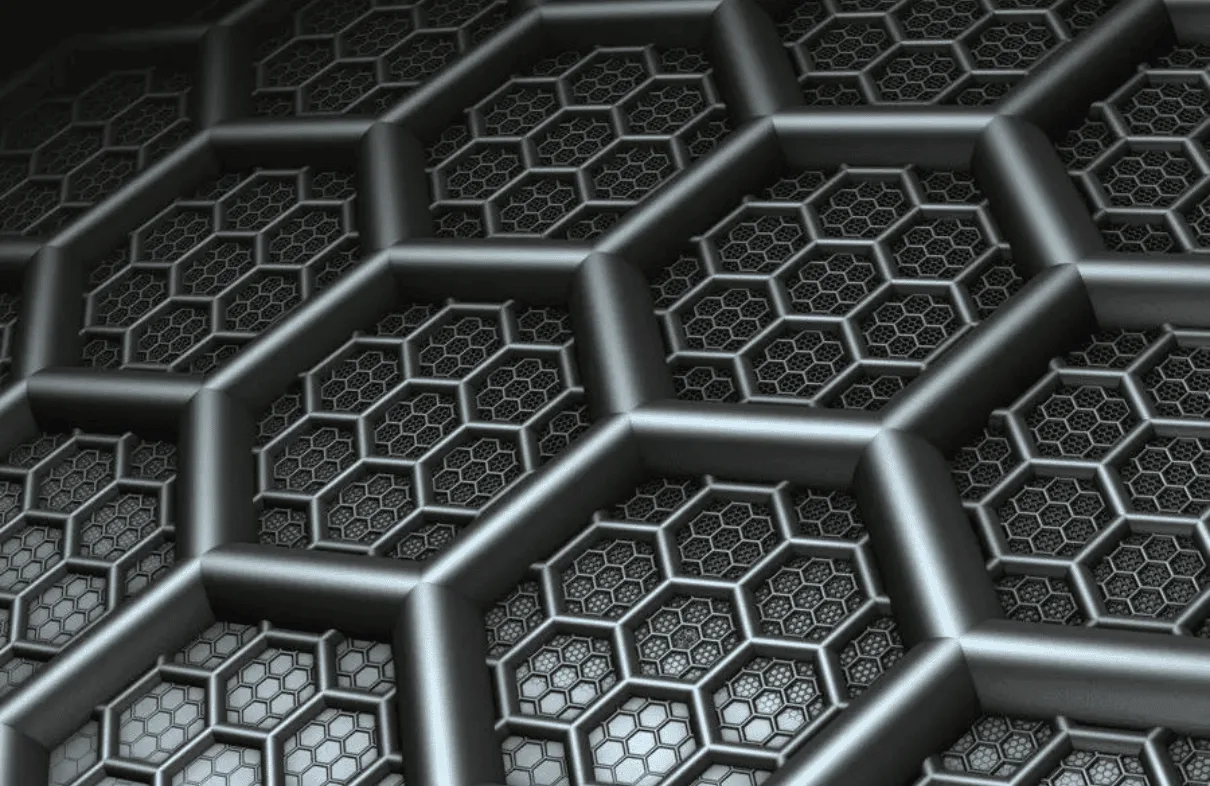
Graphene is a single layer of carbon atoms arranged in a honeycomb lattice. That two-dimensional sheet is what people mean when they search for graphene: one atom thick, electrically conductive, mechanically stiff, and chemically tunable. Stack enough layers and you are back at graphite — the same carbon you find in pencils, batteries, and lubricants.
The commercial problem is not the definition. It is the supply chain. Most graphene on the market is made from mined graphite. Every mine produces a slightly different mineral, so every batch of graphene has a slightly different morphology. Manufacturers who need a drop-in additive cannot tolerate that variance.
Heartland's answer is a bio-based feedstock. The cell wall of industrial hemp fiber is strong and consistent from acre to acre. That continuity is what Imperium Graphene is built on — lab-scale, composite-grade graphene designed to lightweight plastics while adding strength, toughness, and water resistance.
Why is graphene so expensive?
Price follows process, not geology. Graphite itself is cheap. Turning it into graphene is not.
Two industrial routes dominate:
- Exfoliation — mechanically (and sometimes chemically) peeling graphite into few-layer sheets.
- Chemical vapor deposition (CVD) — growing graphene from a carbon-containing gas onto a metal substrate.
Both routes carry high capital cost, high operating cost, and a yield problem. The result is a market where graphene can sell from roughly a hundred dollars a pound for low-grade material competing with carbon black, up to tens or hundreds of thousands of dollars a pound for electronics-grade film. Quality is not a label. It is a function of layer count, defect density, and how well the powder disperses in the host resin.
That price spread is why so many graphene patents never leave the lab. A formulation that works at five grams does not survive a compounding line at five tons.
Why hemp is a better graphene feedstock than mineral graphite
Mined graphite has no obligation to be the same from one mountain to the next. Hemp does. The plant's cell wall is a repeating cellulose–lignin architecture. Grown under contract, processed the same way, it is a predictable carbon input.
That is the same bio-continuity logic behind Imperium Filler and Imperium Masterbatch: control the feedstock, and the additive becomes something a compounder can actually run.
Hemp-derived graphene is not a claim that every monolayer is electronics-grade. Heartland is producing lab-scale quantities of lower-carbon-footprint graphene for composite applications — plastics, rubber, and asphalt — where the job is reinforcement, barrier, and lightweighting, not a phone screen.
For the carbon of the hemp itself, the published number lives on the filler LCA, not on graphene: 1 kg of Imperium Filler removes 2.85 kg of CO2e, measured farm-to-filler under ISO 14040. Do not borrow that factor for graphene. The graphene work is a separate carbon-conversion process still in R&D.
What is graphene used for?
The searches that land here are usually one of four jobs:
- Plastics — stiffness, impact, and barrier at loadings far below talc or glass. Pair with Why Imperium when the swap is a conventional filler; reach for graphene when the part needs nano-scale reinforcement.
- Rubber — a partial stand-in for carbon black in tires, belts, and damping compounds. See sustainable rubber additives.
- Asphalt — toughness and reduced thermal cracking. See sustainable asphalt additives.
- Energy — supercapacitor electrodes and conductive coatings. This is the long-horizon use. It is not a Heartland commercial product today.
If you are compounding today, start with Imperium Filler or Masterbatch. They run on the equipment you already own, beat talc on a per-pound basis at typical loadings, and ship with a published LCA. Graphene is the next carbon in the same American supply chain — not a replacement for a drop-in that already works.
Graphene vs carbon black vs hemp filler
| Additive | What it is | Typical job | Supply risk |
| Carbon black | Furnace-process carbon from fossil feedstocks | Rubber reinforcement, UV, conductivity | Fossil price + Scope 3 |
| Mineral graphene | Exfoliated or CVD carbon from graphite | Nano reinforcement, barrier, conductivity | Cost + batch variance |
| Imperium Filler | Milled industrial hemp | Drop-in for talc, CaCO3, and (at higher loadings) glass | American farm network |
| Imperium Graphene | Hemp-feedstock graphene, lab scale | Composite-grade carbon: strength, toughness, water resistance | R&D → scale |
The right question is not "which carbon is best." It is "which carbon matches the part, the line, and the carbon math."
How Heartland is building a graphene supply chain
Heartland farms industrial hemp across 11 US states, processes it in Detroit, and already sells the fiber and filler fractions. Graphene is a downstream conversion of that same stalk — the same American acres, the same contract growers, the same Engineering Earth rotation.
The product page at Imperium Graphene is the specification surface. This article is the definition surface: what graphene is, why the mineral route bottlenecks, and why a uniform plant cell wall is the input a manufacturer can actually scale.
For the hemp-feedstock query, read hemp-derived graphene. For the longer supply-chain argument, read Bio-Based Graphene Supply Chains. For samples and compounding trials, contact Heartland.
Browse the rest of the library at sustainability news.
Quick answers